Forum
Forum

 Finance
 Specials
 On-chain Eco
 Entry
Entry
 Podcasts
 Activities
 OPRR
OPRR


Is DAO Treasury Accessing USD 1 its Biggest Moat?
Yesterday, BNB broke through $880, setting a new all-time high. In this upward cycle primarily driven by treasury strategies and structured finance, BNB Chain has evolved from being just a high-frequency trading network to becoming the primary battleground for on-chain assetization.
On this front line, Lista DAO has quietly risen to the top, becoming the number one project in terms of TVL on the BNB Chain. It has not only supported the largest staking market in the BNB ecosystem but also led in stablecoins, lending, re-staking, strategy aggregation, and other core asset pathways, with TVL surpassing $3 billion in one go.
Since Trump's return to the White House, the United States has rapidly promoted a series of cryptocurrency-related policies and bills, with the most notable being the "GENIUS Act." This legislation has outlined the regulatory framework for stablecoins and on-chain finance, providing institutional support for the crypto project WLFI led by the Trump family and its USD-pegged stablecoin, USD1.
Against this backdrop, USD1 has gradually become the core settlement asset in the BNB ecosystem, while Lista DAO has grown in a matter of months to become the largest on-chain liquidity hub for USD1, with its treasury size alone surpassing $100 million.
BNBFi's Strategic Gap: Why Does It Need a Lista DAO?
The key contradiction of the BNB Chain lies in its asset richness and abundant liquidity but the lack of a composable on-chain yield structure. Ethereum has established a complete ecosystem of "staking-stablecoin-leverage-strategy-structured assets" through collaborative projects like Lido, Maker, and Pendle, while the BNB ecosystem remains in the "integrate-asset-upon-launch" stage.
For a long time, BNB assets have mostly stayed within the Binance CEX, lacking a standardized on-chain staking protocol and supportive infrastructure for leveraged lending and nested yield for stablecoins. The borrowing proportion in the on-chain TVL is less than 35%, far below Ethereum's 50% or more.
In this context, the systemic concept of "BNBFi" has started to take shape. It is not a standalone project but rather Binance's holistic financial strategy for on-chain assetization. Lista DAO is entering with a "trinity" product structure, becoming the first puzzle piece in turning BNBFi from concept to reality. The emergence of USD1 has, for the first time, given the BNB Chain a prototype of a "structural stablecoin." It is not just a circulating asset pegged on-chain but an engine that can deeply engage in strategy deployment, compound yield, and liquidity aggregation.
How to Build the Lifecycle of BNB On-Chain Assets?
With the goal of "all in BNBFi," Lista DAO has established a complete asset lifecycle framework for BNBFi through a combination of lisUSD, slisBNB, and slisBNBx, starting from the BNB native asset. It enters the mortgage or staking path, mints the stablecoin lisUSD, participates in various strategy deployments, leverages Lending to build leverage or compound returns, bridges to CEX through slisBNBx, and ultimately achieves yield reinvestment and liquidity circulation.
In the future, with the introduction of more assets and the expansion of the market, Lista Lending and its derivative products will become a key underlying layer of the BNB chain's structured financial ecosystem—connecting a full-chain closed-loop system from asset generation, liquidity deployment, to strategy aggregation and yield extraction.
Lista Lending: Rebuilding DeFi Capital Efficiency
Lista Lending launched in April this year, adopting a peer-to-peer architecture similar to Morpho, with features such as modularity, risk isolation, and freely creating markets. Each market can set parameters independently, enabling permissionless strategy deployment and fund distribution.
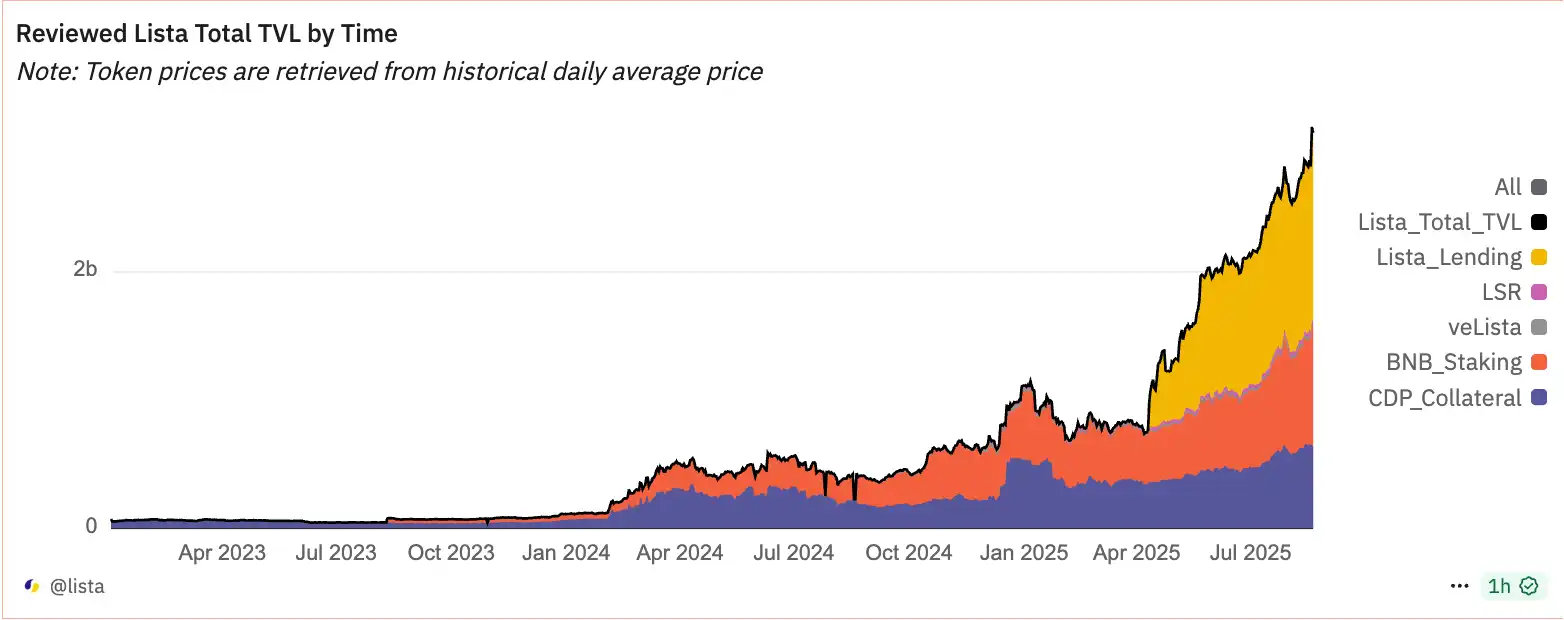
This mechanism has increased the capital utilization on the BNB chain, while completing the Lista product ecosystem: funds can enter the mortgage system through slisBNB, borrow lisUSD to participate in strategy deployment, and assets appreciate in value through circulation among various modules. Currently, Lista Lending's TVL has exceeded $1.5 billion, as shown in the graph, it has become a key driver of Lista DAO's TVL growth since the launch of Lending.
slisBNB and slisBNBx: Bridging Staking and Launchpool Yield
slisBNB is Lista's native liquid staking token, and as a core product, it brings multiple benefits, including validator node rewards, re-staking returns, and more. slisBNBx, as a collateral token, is used to participate in Launchpool and other on-chain launches, allowing users to stake BNB/slisBNB to earn lisUSD while also minting slisBNBx for launch participation, bridging multiple revenue streams.
USD1: Stablecoin Strategy Starting Point and Revenue Hub
In May 2025, Lista DAO completed a deep integration of the Trump family's World Liberty Finance project's USD1 stablecoin, incorporating it into the treasury collateral assets, CDP minting logic, liquidity deployment path, and even the Launchpool allocation mechanism, nearly achieving a "full-path coverage" from user entry to strategy exit. Currently, USD1 has become the starting point for strategies and the core liquidity asset within Lista internally. Leveraging this convergence of politics and finance, Lista DAO has become the hub of USD1 circulation across the network, demonstrating its ability for deep asset integration.
Unlike the anchoring of traditional stablecoins, USD1 within the Lista DAO ecosystem has become an embeddable, composable, and compounding strategic component—this is the fundamental distinction from pure settlement stablecoins like USDT and FDUSD. By August, the circulating supply of USD1 on the Lista DAO platform surpassed the $200 million mark, not only reflecting its high acceptance in the stablecoin market but also validating Lista DAO's capacity as the "liquidity backbone."
Specifically, USD1 within the Lista system plays two strategic roles:
1. As a highly adaptable entry asset, users can deposit USD1 into Vaults to unlock BNB for participation in the Launchpool, or they can collateralize and mint lisUSD in the CDP module to participate in stablecoin mining on PancakeSwap.
2. As a cross-module yield medium, USD1, minted by users through collateralizing assets such as slisBNB, slisBNBx, or LP Tokens, can be used to access Lending and Strategy Vaults to achieve compound returns, completing the full closed-loop cycle from asset collateralization to stablecoin generation, strategy deployment, and yield extraction. The platform has now launched over ten Vaults, including BNB, USD1, and USDT, with Vaults related to USD1 ranking top in terms of deposits, utilization rate, and yield rate.
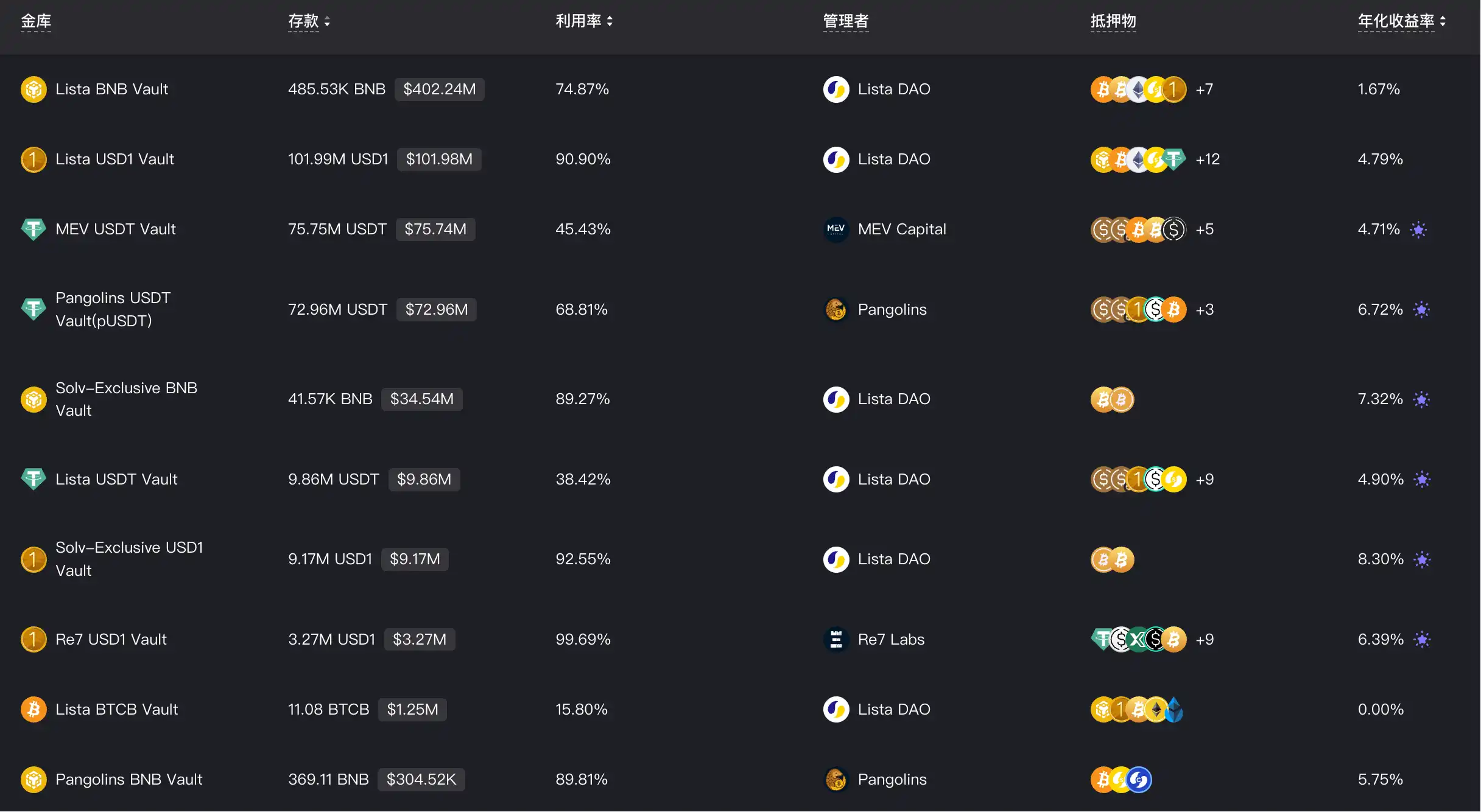
While other protocols are still in the "asset access equals integration" stage, Lista DAO has internalized USD1 as part of its platform revenue structure, enhancing the DeFi usability of USD1 and making it the most impactful intermediary asset in the BNBFi structure. In other words, USD1 is not just an "asset accessed by Lista" but has been transformed by Lista DAO into the "liquidity backbone" and "structured revenue engine," making this deep integration one of Lista's biggest moats compared to other BNB chain protocols.
From lisUSD to USD1, Lista DAO is gradually building a stablecoin layer oriented towards strategic adaptability and yield-generating liquidity, transforming itself from a DeFi protocol aggregator into more of a "BNBFi Central Bank" with open finance hub capabilities.
Lista DAO's Strategic Structural Role: BNBFi's Fund Main Inlet
The rise of Lista DAO is not a breakthrough from a single-point function, but a synchronized effort through an institutional, structural, and strategic triple mechanism, gradually forming an indispensable on-chain infrastructure role. Especially as BNBFi has evolved into the strategic core of Binance Chain assets, Lista DAO is no longer just a lending protocol but has become a standard layer in liquidity provision, asset staking, and yield conversion pathways.
Within the current BNBFi ecosystem, whether it's Pendle's PT, YT-slisBNBx, Aster's asBNB, Solv's solvBTC.BNB, Kernel's structured asset strategies, almost all contract pathways rely on Lista DAO's slisBNB or slisBNBx.
This means that Lista DAO is not just an application protocol but the asset structural master switch in the BNBFi ecosystem. Any funds looking to enter the strategic layer or re-staking path must first pledge or borrow to generate original vouchers through Lista DAO. slisBNB is the generative mouth for composable assets, slisBNBx is the strategy entry voucher, lisUSD is the universal liquidity unit, and Lista Lending is the leverage and yield amplification system engine.
The Sole Bridge for Binance Chain Strategic Assets
For a long time, BNB in the Binance CEX has been challenging to bring on-chain, but Lista DAO provides a path without altering asset custody logic. Users can delegate BNB to generate slisBNB, access on-chain yields; or mortgage BNB to generate slisBNBx to participate in Launchpool fundraising, or borrow lisUSD for leverage and strategy deployment.
Currently, Binance itself is the only on-chain asset that integrates the entire Megadrop, Launchpool, HODLer airdrop process, enabled through Lista DAO's introduction of slisBNB and slisBNBx. This is not a product partnership but a structural path binding.
As of August 2025, the TVL of Lista DAO has exceeded 3 billion U.S. dollars, becoming the actual backbone of the BNBFi structure:
1. slisBNB has become the most mainstream liquidity staking asset on the BNB Chain, with a TVL of 9 billion U.S. dollars, occupying nearly 99% of the network's liquidity staking market share. The comprehensive annualized yield provided by slisBNB is approximately 11.58%, including 10.84% from Launchpool rewards and 0.74% from liquidity staking base rewards, with a total staked amount of about 1,103,931 BNB.
2. The circulating supply of lisUSD is currently around 67.78 million U.S. dollars, backed by a total collateral value of over 500 million U.S. dollars, resulting in an overall collateralization ratio of over 1000%.
3. The TVL of Lista Lending has exceeded 1 billion U.S. dollars, making it the second-largest lending protocol on the BNB Chain.
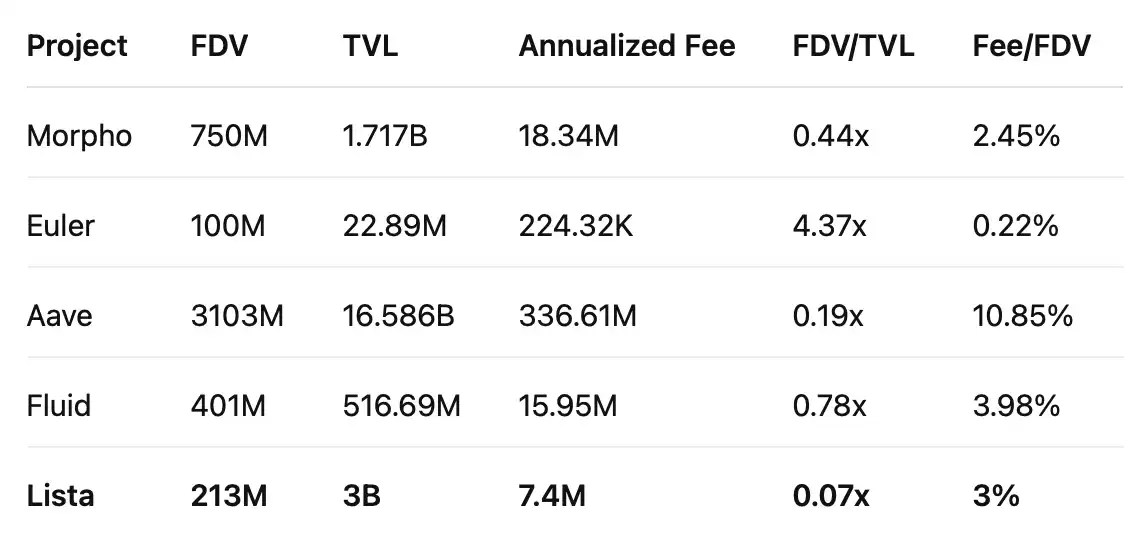
Data Source: Project Website, Coingecko, Defillama
From on-chain metrics, Lista's current FDV is 213 million U.S. dollars, while its TVL has reached 3 billion U.S. dollars, resulting in an FDV/TVL ratio of only 0.07x. This implies that for every 1 U.S. dollar of protocol valuation, it underpins 14.1 U.S. dollars of on-chain assets. This multiple remains significantly ahead when compared to other projects, highlighting Lista's more evident position in a "value crevice."
In comparison, Aave, Morpho, and Fluid have FDV/TVL ratios of 0.19x, 0.44x, and 0.78x, respectively, indicating that the market has partially reflected their protocol maturity or profitability. Although Lista boasts a substantial TVL, it has not yet received a corresponding market valuation, possibly due to its token release schedule, incompletely manifested revenue structure, or the market still observing its protocol's stability and development path.
The success of Lista DAO is not derived from a singular breakthrough but is a result of the synchronous restructuring of institutional architecture, fund pathways, and revenue structures. Whether it is efficiently integrating USD1 to capture market trends or launching the mascot meme Moolah to engage the community, ListaDAO seems to consistently find the optimal balance between structure and sentiment.
With the rapid increase in TVL, Lista DAO is also proactively optimizing its tokenomics. In August 2025, it was officially announced that a 20% of the total LISTA supply had been burned, marking the largest-ever token supply reduction event since the protocol's launch. This action not only strengthened its long-term value proposition but also sent a strong governance signal—Lista DAO is transitioning from a high-growth phase to a new cycle of stable self-reinforcing structure.
The significance of Lista DAO lies in the context of BNB Chain's lack of on-chain financial infrastructure. Its goal is not limited to being a "better lending protocol" but rather the default layer of the "BNB Chain on-chain yield structure," serving as the main engine for BNBFi asset unlocking. Just as Lido has become the standard for Ethereum staking, Lista DAO is becoming the structural entry point for BNB asset on-chainization. In all future paths involving leverage, strategies, re-staking, and yield farming around BNB, Lista DAO cannot be bypassed.
Welcome to join the official BlockBeats community:
Telegram Subscription Group: https://t.me/theblockbeats
Telegram Discussion Group: https://t.me/BlockBeats_App
Official Twitter Account: https://twitter.com/BlockBeatsAsia