Forum
Forum OPRR
OPRR Finance
 Specials
 On-chain Eco
 Entry
Entry
 Podcasts
 Activities


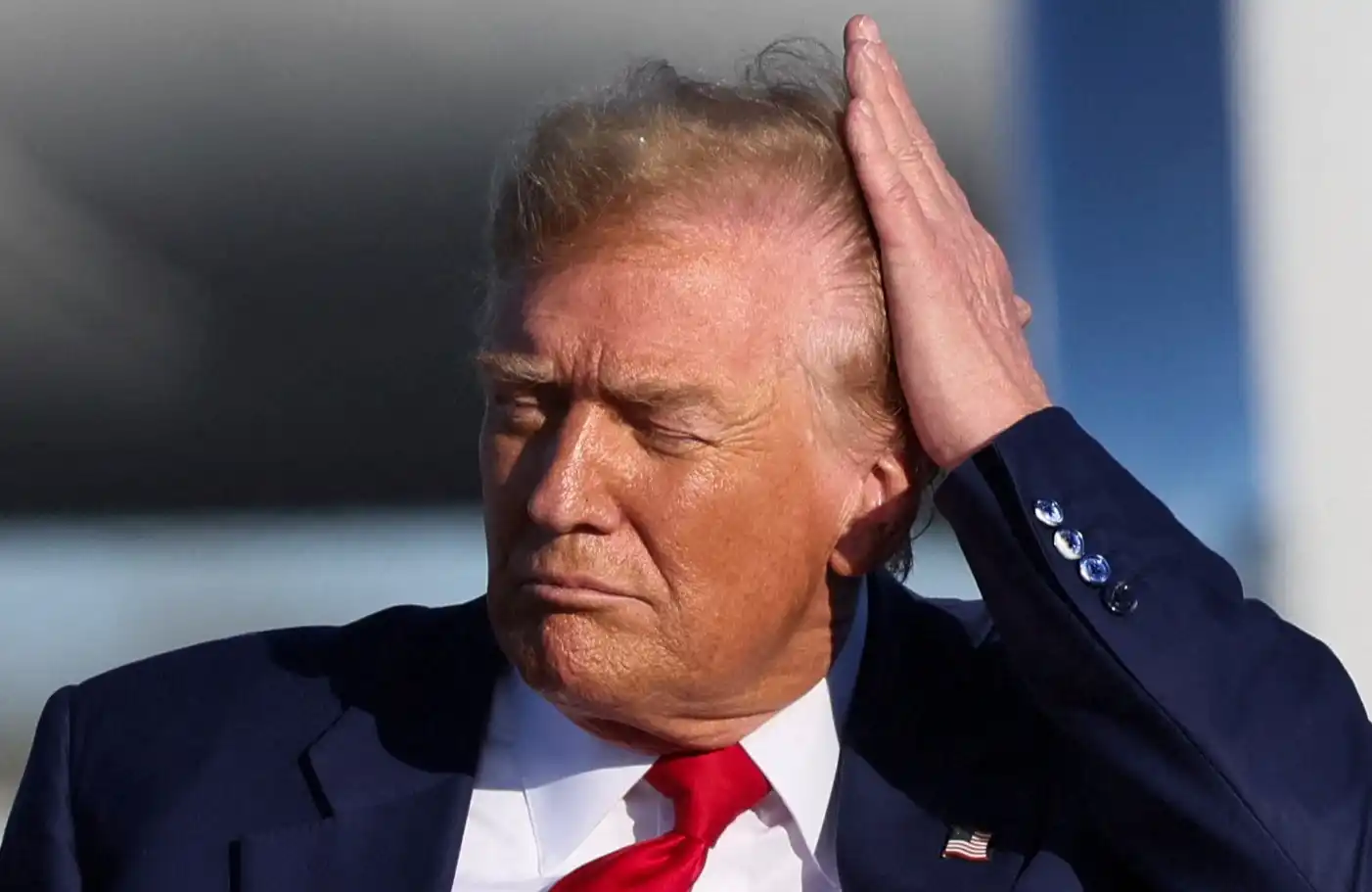
On his 154th day in office, Trump paid off over $100 million in debt

The U.S. President's term is limited to two, so people often say that during the President's second term, the main focus is not on "governing" but on "making money."
On June 23, it was the 154th day of Trump's second term. He used $114 million in cash to pay off in one go his most troublesome debt in his business empire, just 13 days before its loan was due.
This $114 million is equivalent to 400 years' worth of the U.S. President's salary. According to the most widely circulated algorithm — "an average suitcase can hold up to $1 million in $100 bills," it would take at least 114 suitcases to pack and transport this money.
And this loan came from his famous Manhattan skyscraper — 40 Wall Street, also known as The Trump Building.
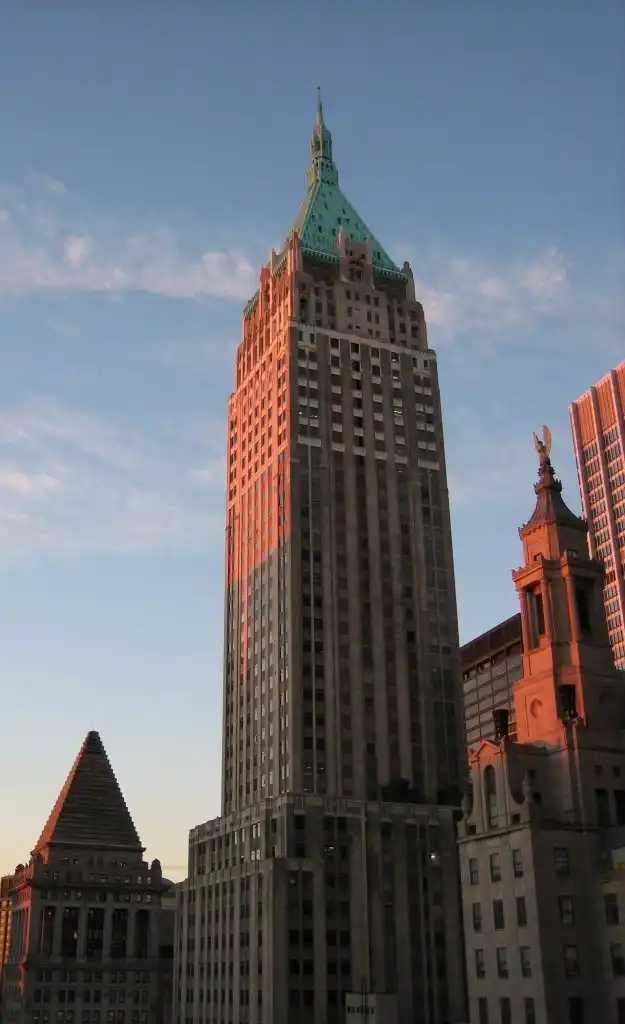
40 Wall Street, also known as The Trump Building
Shadow Bank, Trump's Lender
"When Trump needs a loan, he usually calls Ladder Capital," a source once revealed.
In 2015, as a $5 million loan from Capital One was about to mature, Trump decided to refinance 40 Wall Street. This time, instead of going to traditional banks, he turned to Ladder Capital — a relatively small and lesser-known shadow bank.
After evaluation, Ladder quickly agreed to provide a $160 million commercial mortgage loan for the building, with an interest rate as low as 3.67%. In a matter of weeks, this debt was swiftly packaged, sliced into four notes, and sold to investors along with dozens of other properties, flowing into the secondary financial market.
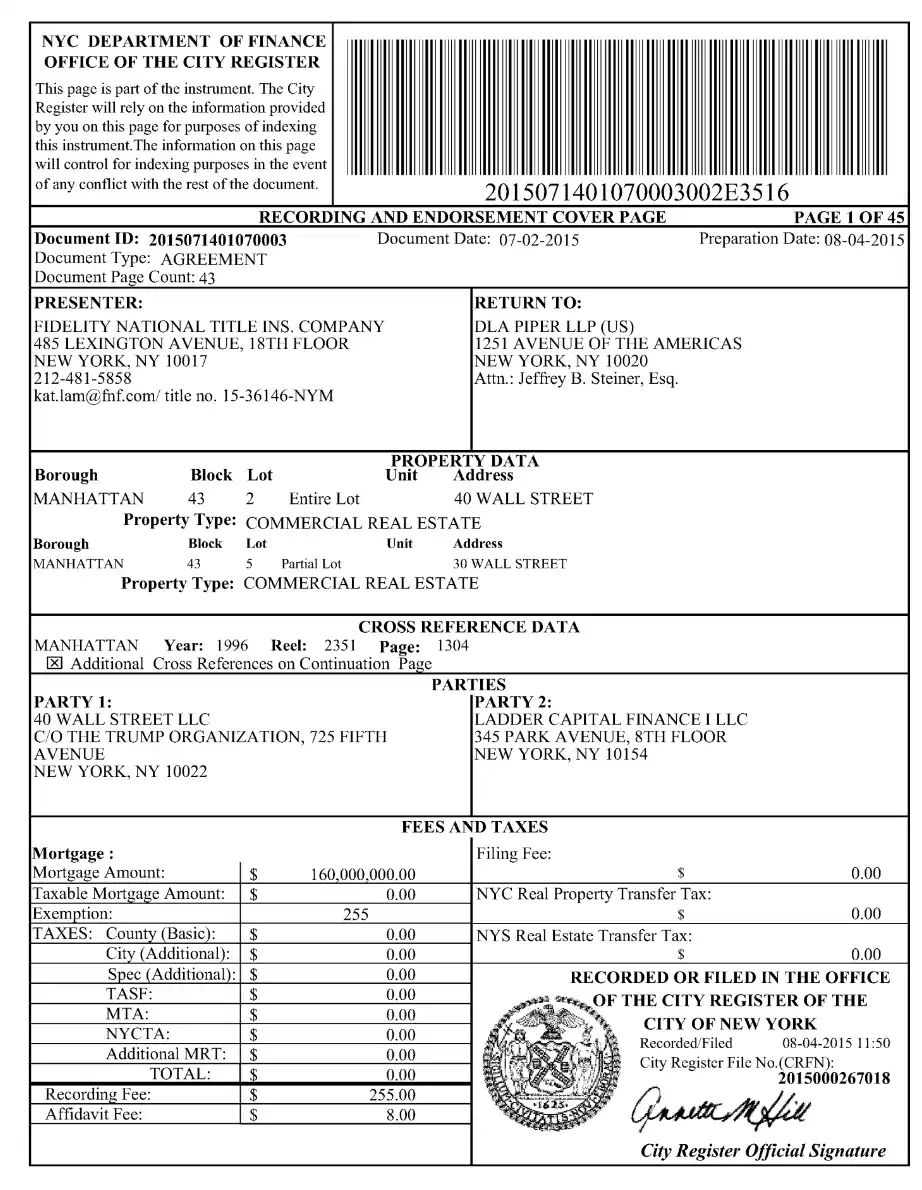
Ladder Capital and the debt notes of The Trump Building
For Trump, this was a timely loan.
In fact, since the early 1990s financial crisis, large banks such as Citigroup and JPMorgan have been reluctant to do business with Trump. Back then, Trump faced multiple investment failures that led him to the brink of bankruptcy, with assets such as the Plaza Hotel and Trump Shuttle being taken over by banks, causing significant losses to several major banks. Deutsche Bank was the last major financial institution willing to support him, but even their relationship soured in 2008 due to repayment disputes related to a Chicago project, leading to a legal battle. Even though Deutsche Bank provided another loan for his Washington project in 2014, the relationship was far from restored to its former state.
However, Ladder Capital not only agreed to lend to him but also offered him an extremely low loan interest rate. Typically, commercial real estate loan rates in the United States range from 5.5% to 10%, with rates for office assets being higher. For a long time, Ladder Capital and Deutsche Bank were the largest creditors of the Trump Organization, with Deutsche Bank charging Trump Group an interest rate between 5% and 7%, making Ladder Capital's 3.67% rate significantly lower by comparison.
Unusual situations are usually accompanied by hidden intentions.
According to revelations, the relationship between Ladder Capital and Trump goes far beyond the surface level of "lender and borrower." The executive team of this company includes Jack Weisselberg, the son of Allen Weisselberg, the CFO of the Trump Organization. This connection allowed Trump to secure hundreds of millions of dollars in funding, even as mainstream Wall Street banks collectively avoided him, and at an extremely low interest rate.
As a Real Estate Investment Trust (REIT), Ladder's core business is to provide financing for high-risk projects that traditional banks dare not touch. They do not rely on deposits from account holders but instead rapidly package and sell loans through asset securitization to gain liquidity and returns. In Trump's 2017 financial disclosure, Ladder Capital held debt related to at least four of his properties, including Trump Tower on Fifth Avenue, with a total debt exceeding $280 million.
As Trump distanced himself from the mainstream financial system, he increasingly relied on shadow banking systems like Ladder. This relationship also sheds light on the rise of New York's shadow banking industry.
Shadow banking refers to a category of financial institutions that are not subject to traditional banking regulations, including hedge funds, private equity, money market funds, and REITs. They provide loans and financing but are not required to adhere to the same regulatory standards as commercial banks. The shadow banking assets in the United States amount to $14 trillion, which is not insignificant compared to the traditional $16 trillion commercial banking system in the United States.
However, shadow banking is a weak link in the U.S. financial system. While commercial banks operate on the basis of government-guaranteed deposits, shadow banks rely on short-term funding—meaning that once market liquidity tightens, their funding chain could instantly break. Just like what Lehman Brothers and Bear Stearns experienced in 2008.
But this is only a small part of Trump's brash business style.
In her book "The Trumps: Three Generations That Built an Empire," author Gwenda Blair points out that Trump was able to smoothly enter the Wall Street banking system in his early years because his father, Fred Trump, was one of the most respected developers in the New York real estate circle. Banks trusted Fred and were willing to give his son an opportunity.
However, after the "Donald-style" recklessness, patience quickly ran out. Bankers began to worry that if they continued to lend to him, not only would they not get their money back, but they might also find it hard to explain to their boards and shareholders. Therefore, several major banks tacitly pushed this "high-risk client" out of the mainstream credit circle.
40 Wall Street, the Unrentable Skyscraper
This Trump building at 40 Wall Street has always been Trump's most talked-about "legendary investment."
He has repeatedly mentioned this deal in public speeches and writings: "In 1995, I acquired this building for only $1 million." In his autobiography "Never Give Up," he wrote, "Sometimes people ask me, what is my most proud investment, and I always think of 40 Wall Street—this building has a kind of special magic that makes me stand out forever."
Indeed, this skyscraper, built in 1930, briefly became the tallest building in the world before the completion of the Chrysler Building. With 70 floors, 282.5 meters high, located in the heart of Manhattan's financial district, it was designated a New York City landmark in 1998. It witnessed the rise and fall of the entire Wall Street, as well as Trump's journey from developer to president.
Many people do not know that Trump does not own the land under this building. He only has a long-term lease, which can last up to 200 years. The actual owner of the land is a group of low-profile German tycoons and industrial giants. In 1995, Trump took over the lease and restructured it, paying fixed ground rent to these Germans every year.
It was in this context that Trump decided in 2015 to refinance this building. He obtained a $160 million loan from Ladder Capital to refinance the property, replacing the $5 million debt due to Capital One that was about to mature.
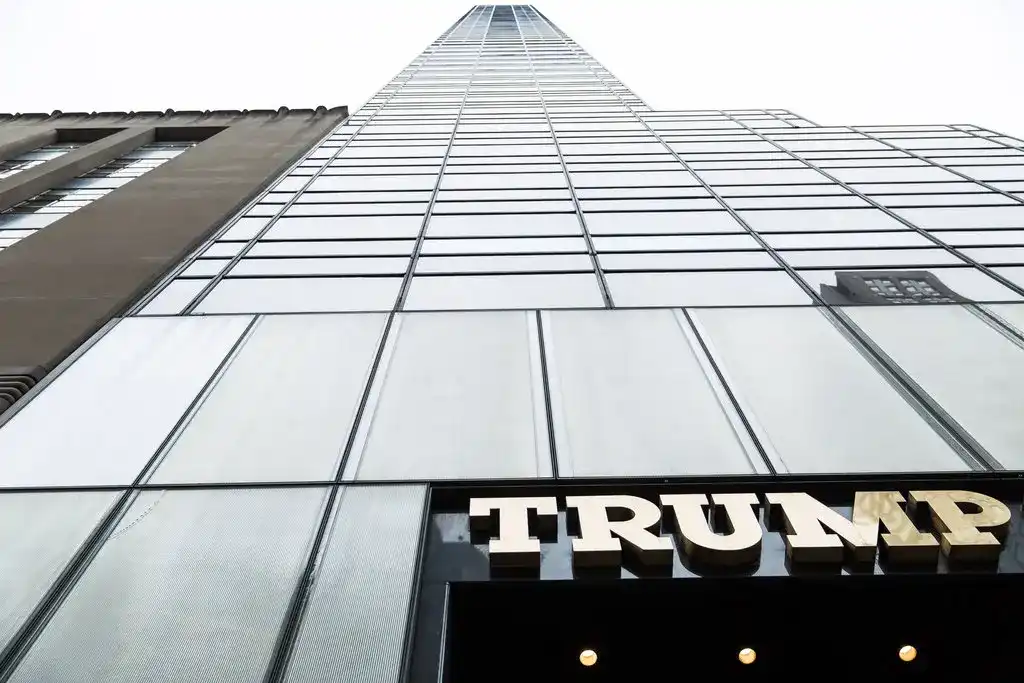
Trump Building, Image Source: New York Times
At that time, Ladder Capital was confident in the building's cash flow. Data shows that in 2015, the building had an occupancy rate as high as 94.5%, 1 percentage point higher than similar office buildings. According to their projections, the building could generate $43.1 million in annual revenue, with total operating costs not exceeding $20.6 million, resulting in a net income of over $11 million.
However, the building's operational performance did not go as smoothly as envisioned in 2015, leading some financial institutions to worry that Trump might default on the loan as before.
Starting in 2019, with the onset of the pandemic and a sharp decline in office demand, the building's occupancy rate plummeted from 89.1% in 2019 to 74.2% in 2023. Rental income also decreased from $41.7 million in 2019 to $30.9 million in 2022, although it slightly rebounded to $33 million in 2023, it never came close to the initial projection.
Meanwhile, operating costs remained high. Rising from $20.9 million in 2017 to $23.2 million in 2023, maintenance and repair costs were nearly double the original estimate. As a result, the building's net operating income in 2023 was only $12.8 million. In August 2023, rating agency Fitch directly downgraded the credit rating of the Trump Organization's loan from investment-grade BBB- to junk-rated BB.
And that's not the worst of it.
The ground rent Trump pays to the Germans was $1.6 million in 2015, but has now risen to $2.3 million. More challenging, according to the lease reset terms after 2033, this ground rent will skyrocket to $16 million, almost swallowing all the profits.
After repaying an annual interest of $9.8 million on the loan, deducting renovation and leasing expenses, Trump truly only makes $1.2 million from this building.
The major tenant, Duane Reade, has already terminated the lease early by four and a half years, and other tenants either delayed occupancy or prolonged lease renewal. By the first quarter of 2025, the building only "barely achieved a break-even point." In the context of rising interest rates and soaring operating costs, this "balance" appears more like a fragile facade.
From Casinos to Skyscrapers: Trump's Six Bankruptcies
How to repay this money has become a key indicator for observing Trump's financial situation and political leverage. What is even more nerve-wracking is that just last year, the New York State Attorney General made it clear that if Trump fails to pay the settlement for a civil fraud case, this skyscraper could face the risk of being seized by the law.
Using personal funds to repay part of the principal and then borrowing new debt to pay the rest is still a possible solution. However, several financial institutions have long expressed concerns—will Trump once again be unable to repay? He may simply declare Chapter 11 bankruptcy for 40 Wall Street.
If that were to happen, it would be his seventh bankruptcy filing. Amitosh Purandare, a finance professor at the University of Michigan, pointed out that unless Ladder Capital still holds a portion of this loan, the company would also be helpless in this situation. "The real victims are those who bought these bonds," he said. "They may be banks, insurance companies, or hedge funds."
Since the 1990s, Trump has been known for his radical style of "high leverage, big bets, and gambling on the future." He has declared bankruptcy for his companies six times.
Trump's first bankruptcy was in 1991 when his Atlantic City casino, once hailed as the "Eighth Wonder of the World," with a cost of $1.1 billion, was primarily financed through junk bonds with a 14% annual interest rate. The 1990 economic recession hit, causing a cash flow crisis in the gambling city, and the casino's operations quickly deteriorated, teetering on the brink of bankruptcy. Trump filed for Chapter 11 bankruptcy protection, divested some assets, and allowed creditors to become shareholders to save the operation.
The second to fourth bankruptcies were in 1992, when Trump Castle, Trump Plaza, and Plaza Hotel, three major real estate businesses, collectively faced distress, almost simultaneously under heavy debt pressures. Plaza Hotel once had debts exceeding $550 million, with cash flow running dry. Trump again filed for bankruptcy reorganization, salvaging operations through stock dilution, debt-to-equity swaps, while retaining management control, keeping the "Trump" brand alive.
During this time, in 1999, Trump's father Fred passed away, and the real estate empire's inheritance fell to the son, marking the official beginning of the "Trump era." However, Trump soon faced his fifth bankruptcy. In 2004, Trump Hotels & Casino Resorts filed for bankruptcy. The company carried $1.8 billion in debt, with nearly $50 million in losses in the first quarter. Another round of Chapter 11. Trump avoided personal financial ruin through capital injections, reducing his holdings, while continuing to collect management fees.
That year, Trump began to frequently appear on TV screens: making cameo appearances in movies, and the reality show The Apprentice was a hit, bringing him back into the public eye. His media exposure soared, but unfortunately, the global financial crisis arrived. In 2008, the collapse of Lehman Brothers triggered a rapid contraction of the real estate market, affecting all of Trump's real estate projects.
In 2009, due to the failure to repay a $53.1 million debt, Trump Entertainment Resorts filed for bankruptcy protection again. In 2014, amid continued deterioration of asset management, he filed for bankruptcy again, ultimately choosing to relinquish control and sell the casino to billionaire Carl Icahn and other hedge funds.
It is worth noting that all six bankruptcies occurred at the corporate level, and Trump himself has never filed for personal bankruptcy. Leveraging legal protection, he successfully shielded his personal assets. More importantly, in each restructuring, he made every effort to retain management or brand licensing rights, ensuring that the name "Trump" could continue to generate cash flow for him.
From his past tactics, Trump is undoubtedly adept at three things: using bankruptcy protection to resolve crises, using public relations and media to repair his image, and using brand licensing to continue monetization. However, this time, Trump used $114 million in cash to fully repay all loans.
However, it was this "full cash repayment" approach that raised new questions: How much money does Trump really have? Where did this money come from?
Boldly Repaying with Cash, Where Did Trump's Money Come From?
Just as news of Trump's loan repayment broke, some sharp-eyed netizens quickly noticed - on June 22nd, a whopping $112 million worth of USDT was burned on the TRON blockchain, and this fund is very likely to be the source of his repayment.
(BlockBeats Note: The burning or transfer of USDT usually means it has been redeemed for dollars - that is, removed from circulation on the chain and returned to a real-world bank account.)

Furthermore, BlockBeats also discovered, according to ARKHAM data, that at 10 am UTC on June 22nd, there was indeed a $100 million worth of USDT transferred from the TRON network to a Binance deposit address starting with TQdkj. The fund's path and timing almost matched some netizens' speculation.
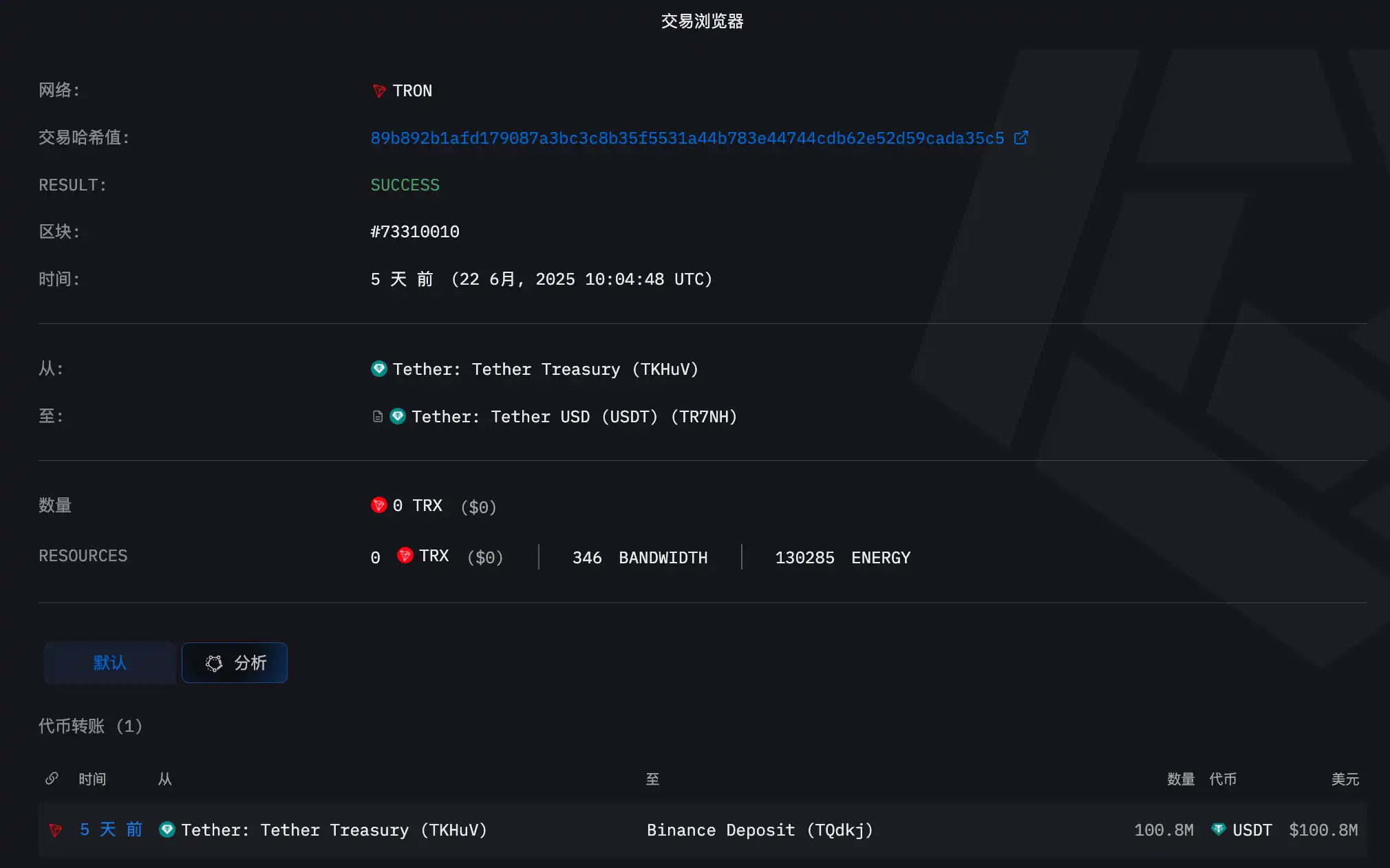
Data Source: ARKHAM
What has drawn even more market attention is another layer of speculation: whether Trump's recent comments on the Israel-Iran issue are not just part of foreign policy but a deliberate attempt to influence market sentiment for personal gain?
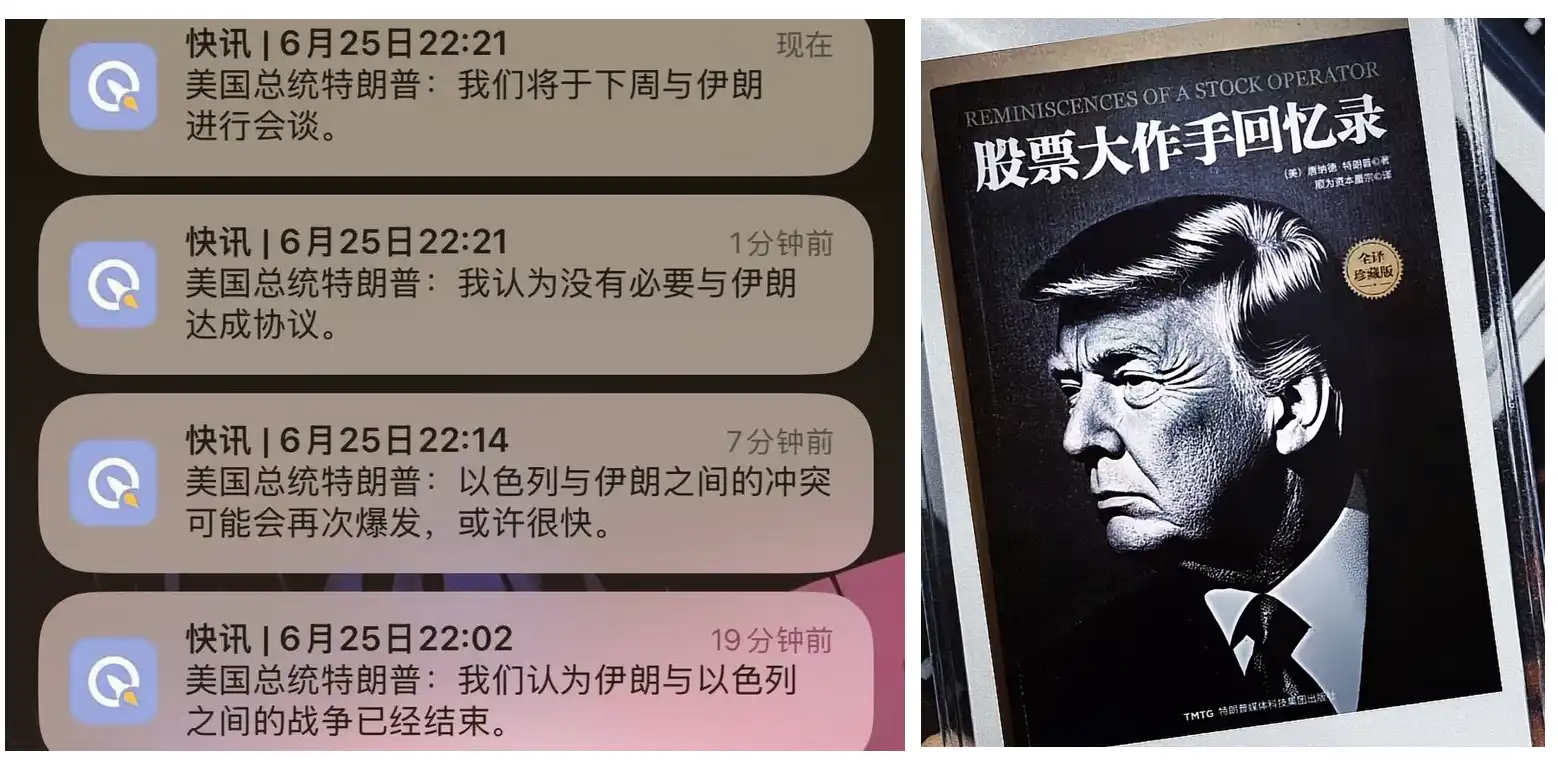
Image Source: Twitter
On June 20, Trump hinted at taking "pause" action against Iran, causing a subsequent stock market drop and a 2% plunge in oil prices. Concurrently, Bitcoin surged by about 2%, rising to $106,000. This market movement closely followed Trump's statements regarding the Israel-Iran conflict, causing an instant shift in market sentiment and a rebound in risk assets.
On the 23rd, he further proclaimed that "Israel and Iran have agreed to a ceasefire," leading to a 5% intraday surge in Bitcoin, breaking the $105,000 mark. As Cryptostocks like Coinbase surged by 12% and MicroStrategy also rose over 1%, the entire crypto sector strengthened in sync. This rhythm of "statement-market reaction-profit-taking" is extremely delicate.
Looking back at his past market behaviors, this is not the first time he has raised manipulation concerns:
On April 9, on the eve of the tariff suspension, Trump posted on Truth Social saying, "Now is a great time to buy, DJT!" A few hours later, he suddenly announced the suspension of tariffs for most countries, resulting in a 9.5% rise in the stock market and an 8% increase in the Dow. Trump usually does not add his initials at the end of posts. These letters happen to be the same as the stock code of the Trump Media & Technology Group, which controls Truth Social. The stock price of Truth Social surged by 22% that day, quickly drawing speculation of "insider trading" and "market manipulation" and congressional attention.
During the peak of the crypto market in March of this year, analysts like Peter Schiff referred to Trump's actions of pumping up crypto assets as a "pump-and-dump" and called on Congress to investigate whether he was manipulating the cryptocurrency market through policy declarations. Furthermore, back in 2019, J.P. Morgan created the "Volfefe Index" based on Trump's tweets to measure his immediate impact on the U.S. Treasury market.
Meanwhile, the discussion around Trump's sources of wealth and market motives has reached a new high.
Last Friday, the Trump team submitted a more than 230-page financial disclosure report, marking the first formal release of his balance sheet since his second term began. This document, with data up to early 2025, covers the fund flows and new assets during the entire 2024 campaign period.
One of the most notable items is the $57 million income he received from selling cryptocurrency tokens through WLFI. WLF is a cryptocurrency company controlled by his family, with Trump's three sons listed as co-founders on the company's website.
In addition to the direct income from the WLFI token sale, Trump also holds 15.75 billion governance tokens through an ETH wallet. The financial document values it at around $1,000-15,000, with the income recorded as less than $201. However, it's worth noting that the initial WLFI token sale price was $0.015, the second round sale price was $0.05, and at the current over-the-counter price of $0.1, Trump's token holdings are valued at $1.57 billion.
In addition to WLFI, the Trump family also holds another more discreet cash-out channel — Meme coins.
His personal Meme coin "$TRUMP," although not included in the financial report due to its issuance in January 2025, we can get a glimpse from the "MELANIA" coin under his wife Melania's name: according to Lookonchain monitoring, over the past 4 months, the Melania team has sold a total of 821,800 Melania coins through 44 wallets, accounting for 8.22% of the total supply, cashing out approximately $35.76 million.
The market value and liquidity of $TRUMP are much higher than $MELANIA. Based on this estimate, the cumulative cash-out amount by the Trump couple through these two coins from the second half of 2024 to the present may have exceeded $100 million.
Furthermore, he also holds between $1 million and $5 million worth of Ethereum, further solidifying his image as the "most crypto-friendly president." He even openly stated during his campaign that compared to previous administrations, he would take a "more relaxed and non-interventionist" regulatory stance.
If cryptocurrency assets represent Trump's hidden wealth, then brand licensing income is his cash cow.
He has licensed dozens of products bearing his name and likeness: from the "God Bless America" edition Bible, limited-edition Trump sneakers, perfume, to Swiss-made "Trump watch," and a signature guitar engraved with "45."
These products brought him a total of millions of dollars in royalty income in 2024, with just three Florida golf courses and the Mar-a-Lago Club contributing $21.77 million in annual cash flow.
Additionally, he is the largest shareholder of the **Trump Media & Technology Group (DJT.US)**, holding over 53% of the shares. The company has been listed on the Nasdaq, with Trump's shares valued at billions of dollars and held in a revocable trust controlled by his eldest son.
Based on the latest estimates, Trump's current net worth is approximately $4.8 billion, with cash and liquid assets accounting for about $400 million. However, he also carries over $600 million in debt, a significant portion of which is directly related to outstanding litigation judgments.
For example, he is required to pay $454 million in civil fraud compensation to the New York Attorney General; in the civil defamation case with writer E. Jean Carroll, he has been respectively ordered to pay $5 million and $83 million; these judgments are under appeal and have not been finally settled.
Having endured six bankruptcy filings, countless lawsuits and trials, and even stepping onto the presidential campaign stage for the first time in American history as a "convicted" individual, Trump has now not only repaid a 10-year loan but has also built a new empire of wealth spanning reality and the virtual world, leveraging cryptocurrency, personal branding, and media platforms.
Perhaps, after dodging that bullet, Trump truly believes that he is destined for greatness.
Welcome to join the official BlockBeats community:
Telegram Subscription Group: https://t.me/theblockbeats
Telegram Discussion Group: https://t.me/BlockBeats_App
Official Twitter Account: https://twitter.com/BlockBeatsAsia